I've been thinking about this for a while. I've wanted temple districts that are a mass of temples to various gods, godlings and deities, as you might find in some sword and sorcery worlds. But at first sight it seemed at odds with the renaissance technology, which, in my mind at least, brings to mind large organized religions.
But I've thought a bit about it, and I think I've come up with a solution that might work. It starts off with five assumptions.
1) Gods are real. The gods often communicate with their worshipers, and there can be no dispute to the fact that they are real.
2) The more worship, the more power. So most deities (and their priesthood) will want to have as large a worshiper-base as possible. Also, worshipers that worship often are worth more than worshipers that worship less often. A ceremony is good, a prayer is okay, an oath is better than nothing.
3) The increase in power is not directly proportional to the amount of new worshipers. Power increases slower than the amount of worshipers. This means that the more worshipers, the less power there will be to each worshiper.
4) There are many gods. If one falls, another is ready to take his place. There are a multitude of unworshiped godlings trying to pry worshipers from the established gods.
5) Worship is not exclusive.A worshiper can worship any amount of gods, though of course there will be less worship to each god.
With these four assumptions in mind, I think of three primary phases in the life of a religion.
The Cults: There is the greatest amount of these. They belong to godlings who have managed to gather a small worshiper-base. The priests have decent amounts of power at their disposal, and can help every one of the cults members if needed. In the smallest of the cults there is enough power that every member can be a divine caster. Cultists have an intimate relationship with their god, often being able to hear him speak from his idol, or at the very least being able to speak to priests which will be able to speak directly to the god. Cultists often focus most of their worship on their chosen god, sending only occasional, minor prayers to major deities. If the cultists devote large amount of time to worship in the form of ceremonies and everyday observance, the resulting power to worshiper ratio may be considerable.
The Pretender Churches: These are cults that are growing too big for the intimacy of the cults. A secondary or even tertiary layer of priests develop which can't communicate directly with the god. The power to worshiper ration decreases, and though there is more power in total, worshipers may start to seek out smaller cults that can better provide for their needs. Most churches fail at this point, as the god gets a reputation for being capricious or isolated.
Some churches manage to remain in this state indefinitely, by taking up a niche where worshipers will rarely seek out aid, but more often remember to send out a prayer. These usually try to spread to as many worshipers as possible, given the smaller amount worship that each worshiper provides. Among these churches some manage to grow large enough, and old enough that they become established churches.
The Established Churches: These churches have grown large enough to become part of everyday life. They have become known for their niche, and people will think to send them a prayer when encountering that niche, whether it is childbirth, battle, strength, or smithing. Their power derives from two, and sometimes three groups.
The first group is the incidental worshipers. They have little relation with the deity, but will send a short prayer, or swear an oath in its name. They are legion, and thus still provide a significant amount of power, despite their lack of consistent worship. Incidental worshipers may be aligned to another deity, or they may not be aligned to any deity, the closest that the world comes to an atheist.
The second group is the priesthood. Incidental worshipers will occasionally donate money to the church, and with enough donations a permanent staff of priests can be established, dedicated to worship of the deity. The hierarchy is likely to be deep, and while the high priesthood will wield significant power, some minor priests may wield less than a cultist. Some churches have dedicated monasteries, where the monks have no divine power, but spend their entire time worshiping, fueling the deity. Some monasteries or priesthoods may run various business schemes, thus giving the church even more money, with which to have more priests and monks.
The third group, that some churches have, are the consistent worshipers. These are everyday people who will still spend time to visit church and participate in ceremonies. They also provide a power boost, and is a good pool to recruit priesthood from and with which to inspire incidental worshipers. Consistent worshipers provide power, but they also drain power, as suitable miracles need to be performed to keep them in the church.
The priesthood and the consistent worshipers are both strongly aligned to the church, thinking of the deity as their one god. They may send the occasional incidental prayer other deities, but dual- or polyworship is not done, unless it is part of the churches doctrine.
Now, all this is background information. Neither the world's populace or the players will be really aware of these simple rules, despite the results being all around them. The primary reason are the churches themselves. Most cults and all churches develop some amount of doctrine, which includes their view on the world. Some cults and churches will claim that their god is the only true god or the only just god or simply the strongest god. Established churches have a wide tendency to purport that the gods of the established churches are different from the minor gods, and that they have always been there. The rising and falling of cults compared to the permanency of established churches gives a sense of a clear separation between deities and the false gods/demons. Every church has its own view of the world, and most will have been formed by gods that want to do their very best to obscure the actual mechanics of divine power. After all, the optimal power to worshiper ratio is a achieved when you are a cult of one.
This, I think, is the religious model that I will be rolling with. Now I just need to find some time to actually make that starting area.
torsdag den 10. februar 2011

tirsdag den 1. februar 2011
A work in progress - always
I spent some time Sunday scattering ruins randomly across the town (using dice to decide latitude and longitude and how many blocks involved. It took forever), as well as marking gates in the walls, and where the walls had been more or less demolished (grey areas such as the park in the southwest).

But it is still a work in progress. Which I decided I would talk a bit about.
Building a world, especially one that is meant for roleplaying, is rarely a task that will ever be finished. Not only can you always add more detail, but even after you have started playing, you can still change stuff. The world created is not an absolute place, an entity in its own right. It is merely a background for the players to adventure in. So sometimes you'll want to change your world, so it will have more or better places to adventure in.
The map above isn't meant for the players. The information it portrays is meant for my own inspiration, which is one of the reasons that I've tried to be as random about it as possible. I've followed the guidelines in City Works (mostly), but whenever there was a choice to make, I tried to let the dice rule. This gives excellent inspiration material, because it will give situations that you wouldn't have thought off yourself. Of course, sometimes I did specifically place tiles in a certain way, because there was certain features that I wanted.
I'll throw in another map:

Here I've marked a few areas, the nature of which I have decided on.
The imperial administration, and the dwarven enclave were handplaced. The imperial district I knew that I wanted, and so placed the government districts from the very start to fit my vision. Though I did randomize which sides of the imperial palace would have administration districts. The dwarven enclave came after I had placed all the districts, as I decided I wanted a dwarven hold. I'm not quite sure yet whether it might be partially or completely in ruins.
I also knew that I wanted a necropolis. But as fate would have it, there was a temple district inside the walls, close to the nobles and the palace, and largely in ruins. Perfect. No need to add one to the hills, where it wouldn't really be integrated in the city.
Then there is Plague Row, and the Ruined University. Neither of those were planned. They just happened to be ruined as completely as they are. And when I saw those areas being ruined, I figured there must be a reason for it. I decided that Plague Row has been walled off at both ends, due to the deadly plague that may or may not have turned the inhabitants into zombies. The areas close to the wall was abandoned by people who didn't want to live that close to the area. The ruined university was destroyed by some magical experiment gone wrong, wrecking the entire university as well as some of the nearby administrative district.
My next step will be to decide on where the players will start off, and then more closely determine the nature of the surrounding area. The entire rest of the map will be left as it is. Maybe I will add further areas to the edge of the city. Maybe I will ruin further areas. The dwarven enclave might, or might not be ruined. But I will get to that as it comes up.

But it is still a work in progress. Which I decided I would talk a bit about.
Building a world, especially one that is meant for roleplaying, is rarely a task that will ever be finished. Not only can you always add more detail, but even after you have started playing, you can still change stuff. The world created is not an absolute place, an entity in its own right. It is merely a background for the players to adventure in. So sometimes you'll want to change your world, so it will have more or better places to adventure in.
The map above isn't meant for the players. The information it portrays is meant for my own inspiration, which is one of the reasons that I've tried to be as random about it as possible. I've followed the guidelines in City Works (mostly), but whenever there was a choice to make, I tried to let the dice rule. This gives excellent inspiration material, because it will give situations that you wouldn't have thought off yourself. Of course, sometimes I did specifically place tiles in a certain way, because there was certain features that I wanted.
I'll throw in another map:

Here I've marked a few areas, the nature of which I have decided on.
The imperial administration, and the dwarven enclave were handplaced. The imperial district I knew that I wanted, and so placed the government districts from the very start to fit my vision. Though I did randomize which sides of the imperial palace would have administration districts. The dwarven enclave came after I had placed all the districts, as I decided I wanted a dwarven hold. I'm not quite sure yet whether it might be partially or completely in ruins.
I also knew that I wanted a necropolis. But as fate would have it, there was a temple district inside the walls, close to the nobles and the palace, and largely in ruins. Perfect. No need to add one to the hills, where it wouldn't really be integrated in the city.
Then there is Plague Row, and the Ruined University. Neither of those were planned. They just happened to be ruined as completely as they are. And when I saw those areas being ruined, I figured there must be a reason for it. I decided that Plague Row has been walled off at both ends, due to the deadly plague that may or may not have turned the inhabitants into zombies. The areas close to the wall was abandoned by people who didn't want to live that close to the area. The ruined university was destroyed by some magical experiment gone wrong, wrecking the entire university as well as some of the nearby administrative district.
My next step will be to decide on where the players will start off, and then more closely determine the nature of the surrounding area. The entire rest of the map will be left as it is. Maybe I will add further areas to the edge of the city. Maybe I will ruin further areas. The dwarven enclave might, or might not be ruined. But I will get to that as it comes up.
lørdag den 29. januar 2011
Districts
After having made the basic map, I start filling in the districts. I start out with the center of the city.
City Works has different city profiles that give different rations of districts. I'm going to start out with the "fading city" which gives a larger than normal ratio of slums. Then after I've created the city, I'll choose areas to have fallen into ruin.
First we have the city in its glory days.

It's a shame that I didn't get to use the hills more, but I'll probably place a necropolis up in the northwestern hills, and maybe add a smaller city to the southeast.
While making the map, I've also come to the conclusion that the setting will be at least slightly industrialized. The industrial districts will be protected by the Industrialists Guild, who rule the areas with an iron hand. The most important consequence from the point of adventurers will be that black powder weapons and other "high tech" equipment will be available. All in moderation though. To start I'll only use the stuff that is described in the basic book (which does include black powder weapons), given that the point of the exercise is to try out the system.
City Works has different city profiles that give different rations of districts. I'm going to start out with the "fading city" which gives a larger than normal ratio of slums. Then after I've created the city, I'll choose areas to have fallen into ruin.
First we have the city in its glory days.

It's a shame that I didn't get to use the hills more, but I'll probably place a necropolis up in the northwestern hills, and maybe add a smaller city to the southeast.
While making the map, I've also come to the conclusion that the setting will be at least slightly industrialized. The industrial districts will be protected by the Industrialists Guild, who rule the areas with an iron hand. The most important consequence from the point of adventurers will be that black powder weapons and other "high tech" equipment will be available. All in moderation though. To start I'll only use the stuff that is described in the basic book (which does include black powder weapons), given that the point of the exercise is to try out the system.
fredag den 28. januar 2011
The City
First up is The City. I'm also currently working on a D&D 4th ed. campaign, and considering starting work on a Mongoose Traveller campaign and a Lamentations of the Flame Princess campaign. And maybe an OD&D megadungeon somewhere in the future.
But first The City. The city is really just supposed to be setting for testing out the Fantasy Craft rules.
The City has a name, but to the inhabitants it is known simply as "The City". It is the heart and capital of an empire, but the empire is in decline. The current emperor has lost all interest in the city, and occupy himself with his capital and his foreign campaigns. No single power really controls the city, and unified law enforcement is non-existent. The city is a warren of feuding noble clans, struggling guilds, gangs, and people just trying to survive. What "law enforcement" does exist is locally organized, and the law they enforce is formulated by their employers, whether they be guards of the nobles, watchmen of the guilds, or simply a militia raised to protect a neighborhood.
The starting idea was purely for the place to be a quick testing ground, where I could make an adventure around The Alexandrian's idea of node-based design.
I spent an evening with City Works from Fantasy Flight Games, and made the following rough map of the city's neighborhoods.

City Works work with city blocks that are approximately 500 ft on a side, with 100 inhabitants. So this city has approximately 80.000 inhabitants, and is some three miles across. The colors denote the type of district.
But then I got side-tracked. I'm now thinking on a setting that might work for an extended campaign. Not because I'm necessarily going to run an extended campaign, but because I liked the ideas I got. Mostly I'm thinking larger. Much larger.
The empire is in decline. When it was at its height, the population numbered in untold millions. Now large parts of the city is abandoned and in ruins due to plagues, fires or other incidents. One can walk for hours and even days to reach the inner parts of the ruined areas. Goblins, undead, vile cults and other enemies of man lurk in ruins.
So, I'm starting the map from scratch. For this city I'm going to work with a larger scale. I wanted those big ruin areas with multi-hour walks. So I decided to first start by constructing the city from megablocks, which would contain multiple city works blocks. After some calculations, I decided that I would go with megablocks that were 25 city blocks wide on each side (2.4 miles wide, and with a population of 62500 each). Currently I'm thinking I'll have 1600 of these megablocks, for a total theoretical population of 1 billion inhabitants when the city was at its height. I guess that counts as untold millions, though the goal here is the city's size, not its population.
To spread out the districts a bit (City Works wants all the government districts to lie in the city center for example) I'm going to construct the city as three cities that grew together, two of 500 megablocks, and one of 600 megablocks.

This is the basic map I'll be working from. We got a river running down the center, and tall ridges rising on either side. The red lines are city walls. Most of the interior walls will be in some state of decay, and passages broken through in many places, but they will still serve to split up the districts once I get around to placing those.
But first The City. The city is really just supposed to be setting for testing out the Fantasy Craft rules.
The City has a name, but to the inhabitants it is known simply as "The City". It is the heart and capital of an empire, but the empire is in decline. The current emperor has lost all interest in the city, and occupy himself with his capital and his foreign campaigns. No single power really controls the city, and unified law enforcement is non-existent. The city is a warren of feuding noble clans, struggling guilds, gangs, and people just trying to survive. What "law enforcement" does exist is locally organized, and the law they enforce is formulated by their employers, whether they be guards of the nobles, watchmen of the guilds, or simply a militia raised to protect a neighborhood.
The starting idea was purely for the place to be a quick testing ground, where I could make an adventure around The Alexandrian's idea of node-based design.
I spent an evening with City Works from Fantasy Flight Games, and made the following rough map of the city's neighborhoods.
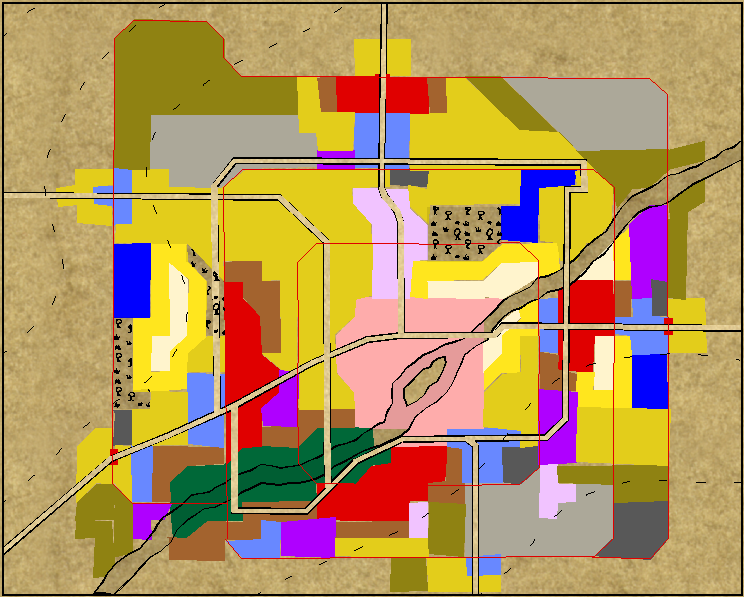
City Works work with city blocks that are approximately 500 ft on a side, with 100 inhabitants. So this city has approximately 80.000 inhabitants, and is some three miles across. The colors denote the type of district.
But then I got side-tracked. I'm now thinking on a setting that might work for an extended campaign. Not because I'm necessarily going to run an extended campaign, but because I liked the ideas I got. Mostly I'm thinking larger. Much larger.
The empire is in decline. When it was at its height, the population numbered in untold millions. Now large parts of the city is abandoned and in ruins due to plagues, fires or other incidents. One can walk for hours and even days to reach the inner parts of the ruined areas. Goblins, undead, vile cults and other enemies of man lurk in ruins.
So, I'm starting the map from scratch. For this city I'm going to work with a larger scale. I wanted those big ruin areas with multi-hour walks. So I decided to first start by constructing the city from megablocks, which would contain multiple city works blocks. After some calculations, I decided that I would go with megablocks that were 25 city blocks wide on each side (2.4 miles wide, and with a population of 62500 each). Currently I'm thinking I'll have 1600 of these megablocks, for a total theoretical population of 1 billion inhabitants when the city was at its height. I guess that counts as untold millions, though the goal here is the city's size, not its population.
To spread out the districts a bit (City Works wants all the government districts to lie in the city center for example) I'm going to construct the city as three cities that grew together, two of 500 megablocks, and one of 600 megablocks.

This is the basic map I'll be working from. We got a river running down the center, and tall ridges rising on either side. The red lines are city walls. Most of the interior walls will be in some state of decay, and passages broken through in many places, but they will still serve to split up the districts once I get around to placing those.
Of Gods and Dice
I've been roleplaying for a long time, and done world building for almost as long. A year or two ago, I discovered blogs, or more specifically roleplaying blogs.
I do a lot of world building. I start with an idea, and then start working on it. Often I soon get another idea, and start working on that instead. My hard-disk is littered with the neglected corpses of past projects.
So I figured I'd start documenting my work online. Do one of those world-building blogs. I'll upload what I'm working on at the moment. And who knows. Maybe you'll like it.
I do a lot of world building. I start with an idea, and then start working on it. Often I soon get another idea, and start working on that instead. My hard-disk is littered with the neglected corpses of past projects.
So I figured I'd start documenting my work online. Do one of those world-building blogs. I'll upload what I'm working on at the moment. And who knows. Maybe you'll like it.
Abonner på:
Opslag (Atom)